In this article
A person may need information in a different format and also have a question about what that information means. Those are related experiences, but they are different questions. Keeping them separate can make a request clearer and reduce the amount of private information shared with the wrong recipient.
Name the access barrier first
A reading barrier might be that text is too small, an image lacks a useful description, an audio version is needed or a page cannot be used with a keyboard. The first task is to identify what prevents access to the information. That description does not, by itself, establish anything about eligibility for a benefit or the outcome of an application.
SSA’s special-notice page describes alternative ways of receiving information in its stated context. Its page for people who are deaf or hard of hearing describes reasonable accommodations, including interpreter options. The details and conditions belong to those official pages. We do not reproduce an account-preference workflow or tell an individual which arrangement applies.
Separate three layers of a notice
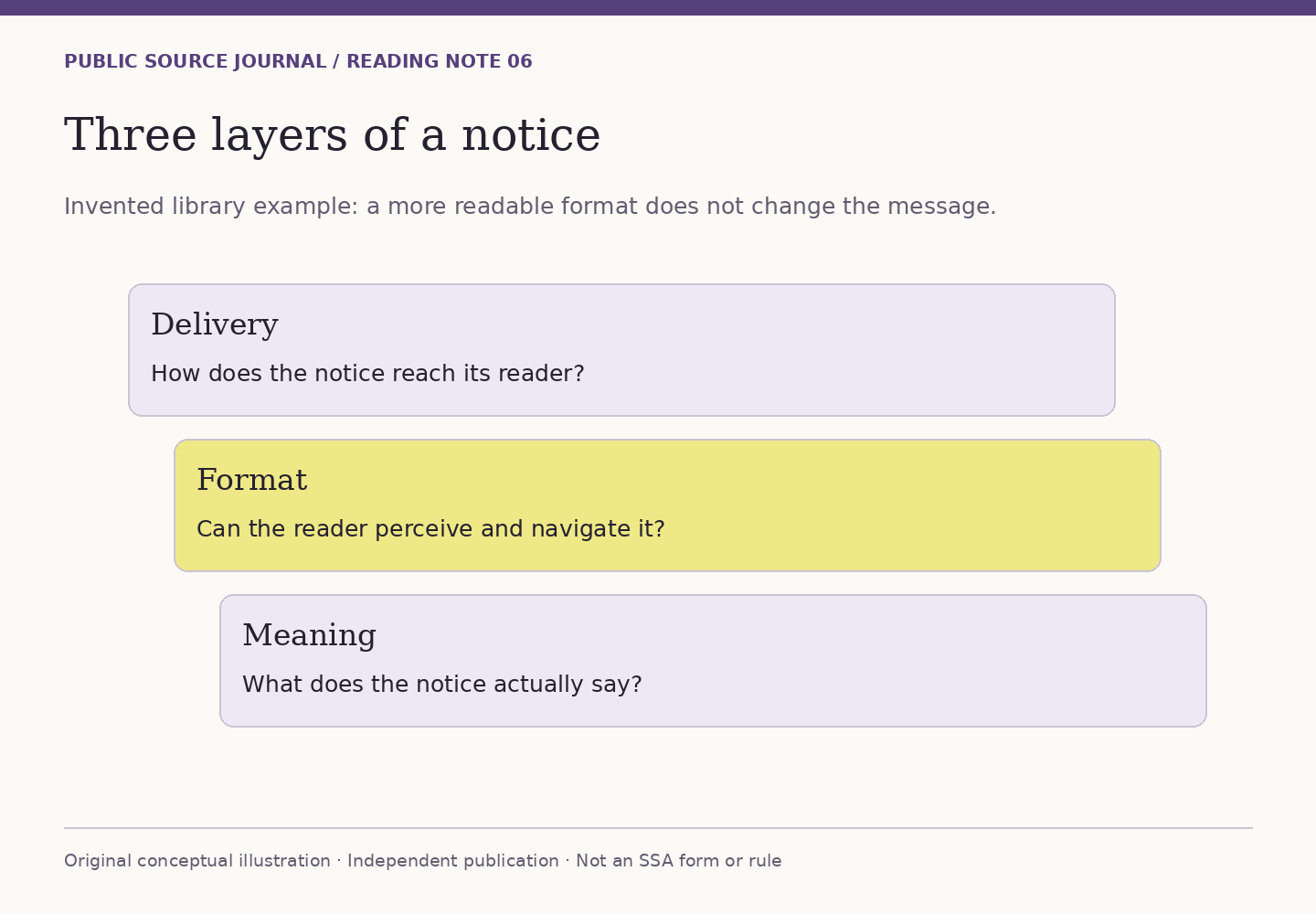
Think of an invented community-college library notice. The delivery layer is how the notice reaches the reader. The format layer is whether the text can be perceived and navigated. The meaning layer is the actual message about a borrowed book. Making the text larger improves access to the meaning; it does not change the due date inside the notice. The example is fictional and does not state an SSA deadline or legal requirement.
This three-layer distinction can guide a reading conversation. “I cannot read this format” is different from “I do not understand this sentence,” which is different again from “I disagree with this decision.” Each may need a different kind of help. An independent editorial publisher should not pretend that an accessibility fix gives it authority over the underlying decision.
Describe a website problem without a personal history
For a problem on this Journal, tell the publisher the public page address and what you could not do. For example: “The topic selector is not reachable with my keyboard,” or “The diagram’s description does not explain the arrows.” That gives the publisher a concrete task to reproduce. A diagnosis or benefits record is unnecessary for an editorial accessibility report.
For an issue on SSA’s site or with agency communications, use SSA’s own accessibility or contact resources. The agency’s accessibility page asks for the address and a description of the problem. This Journal cannot submit or adjudicate accessibility complaints and does not give legal advice about rights, deadlines or remedies.
Avoid the false tradeoff
Needing a different format does not mean a reader should settle for an untraceable third-party copy. Conversely, locating an official source does not guarantee that every format will work well for every person. Source identity and usable presentation are separate qualities worth checking. A useful reading resource should be clear about both.
Our diagrams include text alternatives and captions, and the article directory works without the optional filtering script. Those are implementation choices, not a certification that every assistive-technology combination has been tested. If you encounter a barrier, use the editorial contact. For more on interpreting a source without adding assumptions, see reading the conditions in an FAQ.
Sources and limits
- External official SSA source: Special Notice Option For The Blind Or Visually Impaired. SSA distinguishes notice formats and communication preferences. Article does not reproduce preference-change steps or determine program eligibility.
- External official SSA source: How to Request a Reasonable Accommodation. SSA describes free reasonable accommodations and currently displays general phone hours of 8 a.m.–7 p.m. The differing hours on another SSA page are reported as a source inconsistency, not a service-hours determination.
- External official SSA source: Accessibility Support. SSA describes technology and program accessibility, asks accessibility feedback to identify the page and problem, and currently displays general phone hours of 8 a.m.–5:30 p.m. This collection does not decide legal rights or certify accessibility.
Public sources checked October 8, 2026. Original examples are illustrative, not official text or a decision about any person.