In this article
A frequently asked question is designed to be found quickly. That convenience can encourage a second, less helpful shortcut: reading only the first sentence and treating it as a complete rule. A short answer may still depend on the program, audience, situation or time period named around it. The useful skill is seeing the condition before drawing a conclusion.
The question is part of the answer
SSA’s FAQ index organizes general information under distinct topics. That organization matters because similar words can belong to different contexts. A reader who arrives from a search result should inspect the question and its topic, not only the highlighted snippet. A search engine’s excerpt is a selection of text, not the full explanation or an agency response to your own facts.
Read the title aloud as a question. Then identify who or what the answer is describing. If you cannot name the audience from the page, keep that uncertainty visible. Do not borrow an audience from the question you hoped to answer. The source may be useful without being the right source for this particular reading task.
Mark the words that carry the condition
Words such as “may,” “if,” “usually,” “unless” and “in some cases” do real work. Removing them often strengthens the claim. Conversely, seeing “may” does not tell you which individual qualifies. These are cues to inspect the surrounding explanation, not an invitation to create a home-made eligibility test.
Consider an invented community-center answer: “Visitors may use the archive room if a volunteer is available; some materials require an appointment.” A careless note becomes “Visitors can use the archive.” A better note preserves the dependency on a volunteer and the separate appointment condition. Neither note establishes that the room is open at the moment someone arrives. This is a reading example, not an SSA requirement.
Build a small claim frame
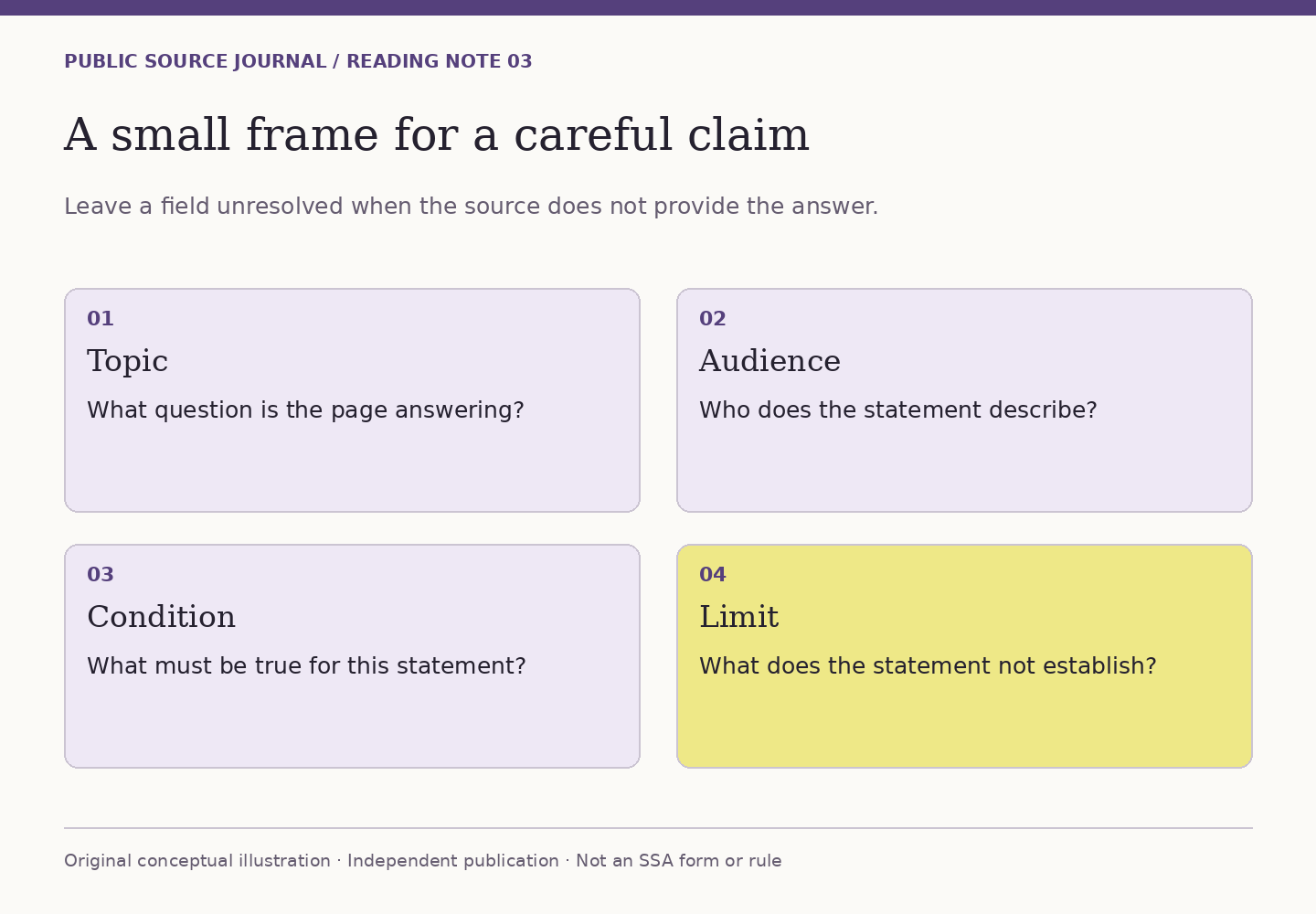
Write four labels: topic, audience, condition and limit. Under each, paraphrase only what the source supports. Leave a label blank when the answer does not supply it. The blank is useful; it identifies the next question. Filling it from memory or another program’s FAQ makes the note look complete while making the evidence weaker.
Now compare the note with the original sentence. Did “can” become “will”? Did a possibility become a guarantee? Did an example become an exhaustive list? Did a general statement become “everyone”? These changes can happen even when the writer is trying to be helpful. A second reading focused just on qualifiers often catches more than reading the whole page faster.
Follow context without building a transaction
A related public explanation may resolve a term or narrow the scope. Read those sources when useful, but recognize when the question becomes personal: a status, decision, calculation or application. The Journal does not collect the details needed for those matters and cannot give an individual determination. Do not enter a Social Security number, medical history or financial details into this site’s search or email.
A successful FAQ reading can end with a better question rather than a final answer. For example, “Which audience does this condition describe?” is more precise than “Is this always true?” For the next step in your reading practice, see a plain-language rewrite that keeps its qualifiers.
Sources and limits
- External official SSA source: Frequently Asked Questions. Supports that the FAQ index organizes general questions by program and topic. The fictional qualification examples are original, not SSA rules.
Public sources checked October 8, 2026. Original examples are illustrative, not official text or a decision about any person.