In this article
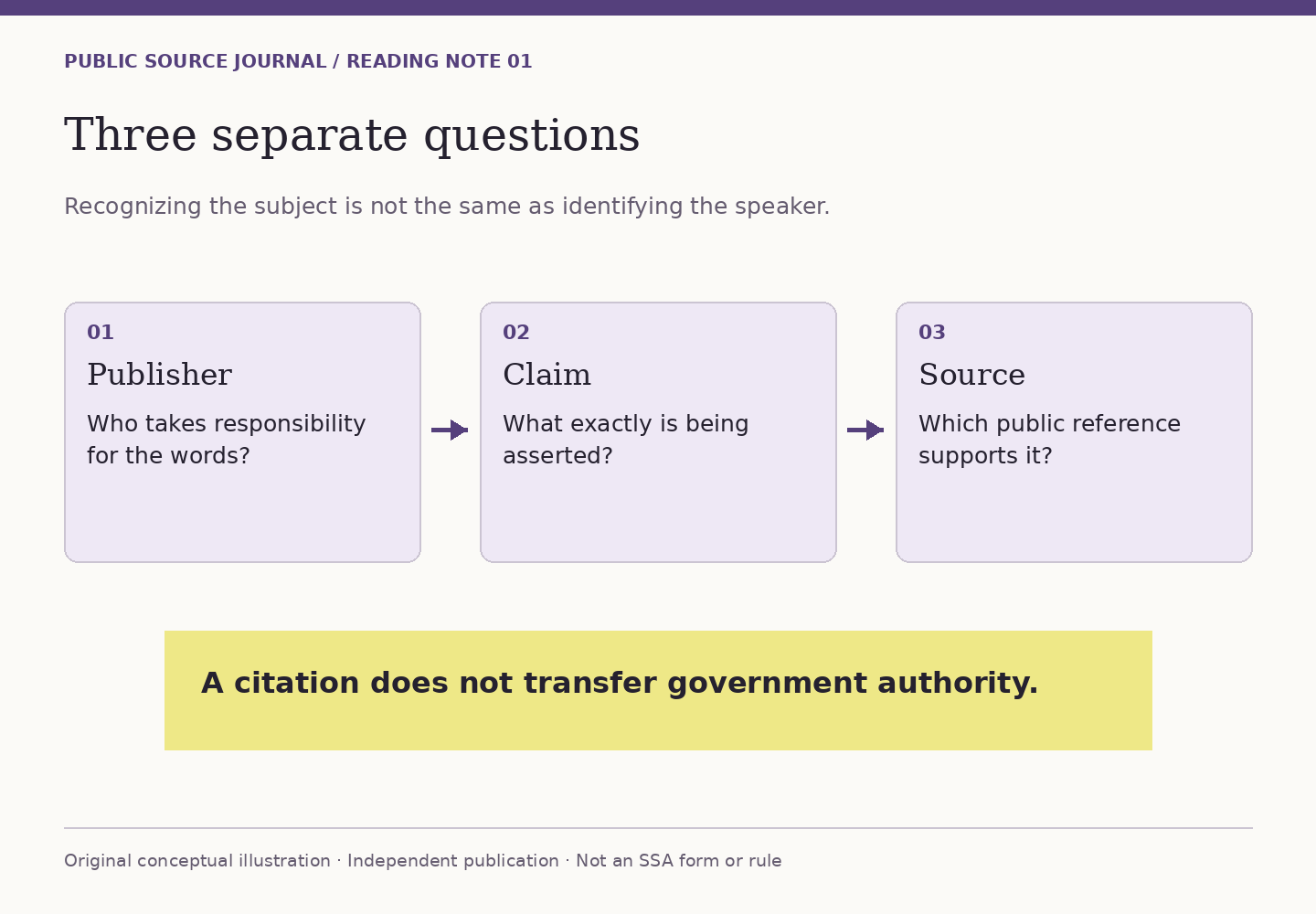
A page about Social Security can be written by the agency, a journalist, a commercial publisher or someone pretending to be the agency. The subject alone does not identify the speaker. Start with a smaller question than “Is this useful?” Ask who is taking responsibility for the words, and whether that person or organization has the authority relevant to your purpose.
Treat appearance as a clue, not proof
A familiar color, a flag-like shape or the phrase “Social Security” can be copied. Even an accurate paragraph may appear on a site with a misleading service offer beside it. A visual resemblance should never substitute for identifying the publisher. This Journal deliberately uses its own name and design. We are an independent editorial publication, not SSA, an authorized benefits processor or a government website.
The official public website is SSA.gov. Its account information page explains the .gov identity cue and HTTPS connection cue. These answer different questions: the domain helps identify the organization; HTTPS concerns the connection. A secure connection to a different publisher does not turn that publisher into the government. Likewise, text that merely includes “ssa.gov” is not evidence that the browser is currently at that address.
Read the address as an address
Consider this invented example: a printed reading card says “Reference: ssa.gov” in large letters but labels its publisher “Example Reading Club.” The reference names a source, while the publisher remains the club. Nothing on the card transfers SSA’s authority to the club. Apply the same distinction to a web article. A source link is an opportunity to inspect evidence, not a badge of government approval.
When a public page links onward, notice that you are leaving one publisher’s context. Read the destination rather than assuming that every later page inherits the original page’s purpose. We label official sources as external. That label is our description of the source checked, not a claim that the Journal is inside an official service or can pass your details to one.
Match authority to the question
An independent article can help you understand a term, inspect a chart or spot a missing qualification. It cannot establish your personal status in an agency system. A public agency explanation is stronger evidence about what the agency says generally, but still may not resolve an individual situation. A personal account, a notice and an official conversation each have their own context. Avoid collapsing all of these into one idea of “the answer.”
Here is a public-only exercise. Choose a general article, without entering any personal information, and write three headings on paper: publisher, claim, source. Under claim, record a short paraphrase. Under source, record the public reference that actually supports it. If the reference supports only part of the claim, circle the unsupported part. You have found a question to investigate, not proved the entire article false.
Keep a useful stopping point
Stop using an independent reading site when the task becomes signing in, proving identity, applying, changing records or resolving your own case. Start from verified official channels for those tasks. Replacement Social Security cards are free from SSA; this Journal charges no fee and does not provide government services. The value of a reading publication is helping you understand the boundary before you reach it.
Continue with separating explanation from action or the public-reading and account boundary.
Sources and limits
- External official SSA source: SSA.gov public homepage. Confirms the official SSA website and its separation of public information, benefit categories, account links and services. This collection interprets page purposes; it does not reproduce service instructions or determine eligibility.
- External official SSA source: my Social Security. Official page distinguishes the personal account from public information and describes account services and identity partners. No sign-in, identity check or account feature was tested.
- External official SSA source: replacement-card fee warning. SSA identifies replacement Social Security cards as free. Some other records or services may have fees; no universal no-fee claim is made.
Public sources checked October 8, 2026. Original examples are illustrative, not official text or a decision about any person.