In this article
Two pages can mention the same program and do very different things. One defines a term. Another explains a general process. A third begins an official transaction. A fourth reports information specific to a person. Knowing the topic is only half the reading task; knowing the page’s job keeps you from asking it to prove something it cannot.
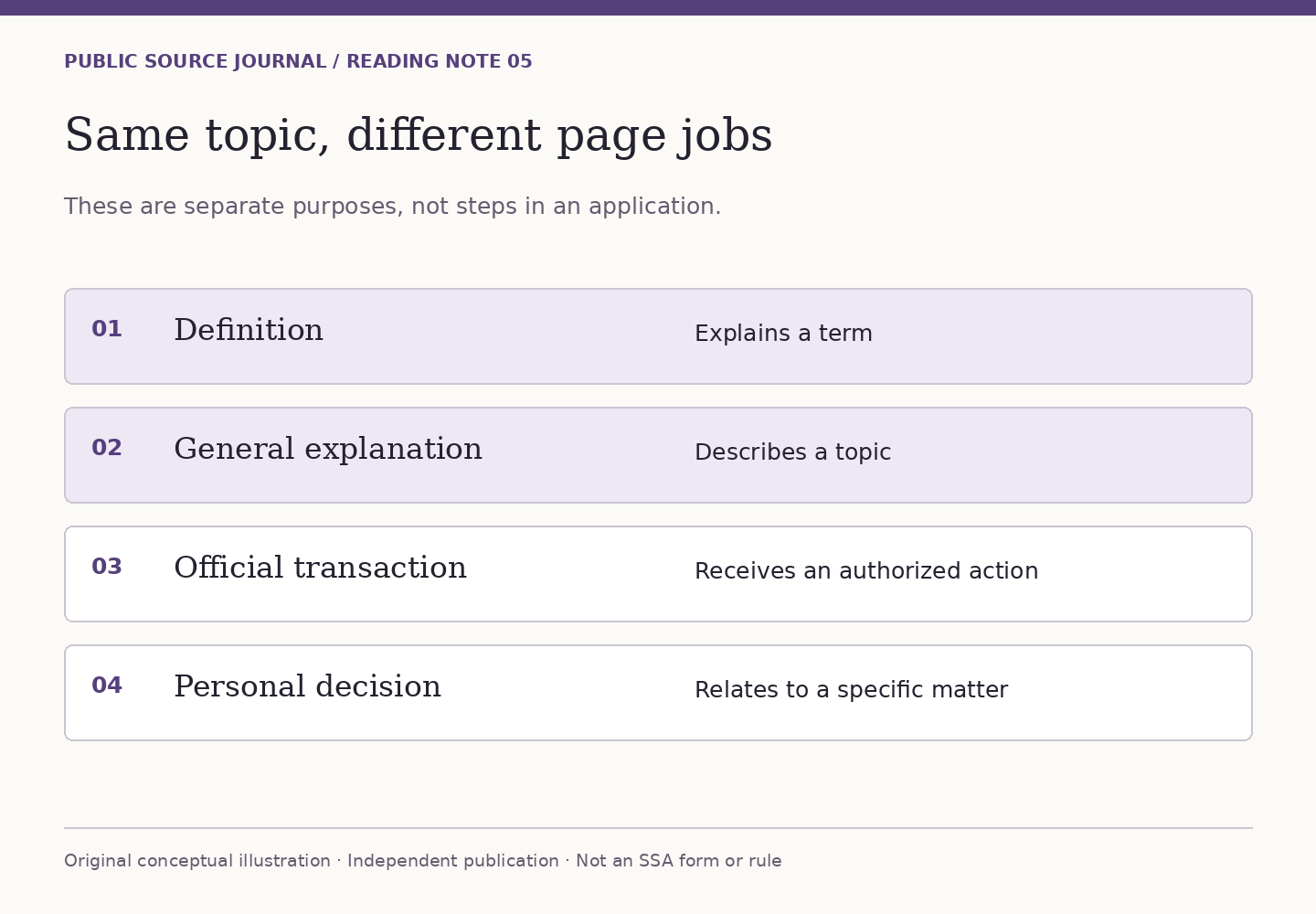
Read the verbs on the page
SSA’s homepage groups public information and official services in the same overall website. Its navigation uses different verbs for different activities. This collection uses that public structure as context, not as a map for completing transactions. We do not reproduce an application flow, provide eligibility screening or collect information for official services.
When reading any page, notice its main verb. “Learn” suggests an explanation. “Read” suggests reference material. “Sign in” marks a move toward an account context. A form or submission control may mark a transaction. The verb is a useful first clue, but read the surrounding text before deciding what the page promises or requires.
Separate understanding from evidence
Imagine an invented public garden website. A glossary explains “season pass.” A general page explains how the garden organizes visits. A service page offers a pass request, and a private message confirms a particular visitor’s reservation. Reading the glossary does not create a reservation. Seeing the request page does not prove that a request was accepted. The different pages share vocabulary without sharing the same evidentiary role.
This distinction matters for reading about public programs too. A general explanation may help you understand a notice, but it does not replace that notice or resolve a personal case. An independent article may explain how to read a condition, but it cannot determine whether the condition is satisfied by facts it has not reviewed and is not authorized to adjudicate.
Draw a boundary before personal data
This Journal remains on the public-reading side. There is no account sign-in, benefits application, card request, document upload, paid assistance package or personal eligibility calculation. Our interactive reading-path selector uses preset educational interests and produces links to articles in this publication. It is not a service locator based on your personal situation.
If your task requires identifiers, medical records, financial information or credentials, stop using this publication for that task. Use the relevant verified official service. Do not send those details to our editorial inbox to ask which option applies. The absence of a form here is deliberate: a publication should not imply that it can handle a transaction merely because it discusses related words.
Know what a link does and does not mean
A source link lets you leave this site and inspect a reference. It does not enroll you, transfer an application, reserve an appointment or submit an application. Your browser will make a new request to the destination, whose own policies apply. We label official external links so that the change of publisher is visible.
SSA provides replacement Social Security cards free of charge. This site does not charge for access to official information or act as an intermediary. If an independent explanation has helped, its job is complete when you understand the reading question and the boundary around it. Continue with public reading versus a personal account to examine that boundary more closely.
Sources and limits
- External official SSA source: SSA.gov public homepage. Confirms the official SSA website and its separation of public information, benefit categories, account links and services. This collection interprets page purposes; it does not reproduce service instructions or determine eligibility.
- External official SSA source: replacement-card fee warning. SSA identifies replacement Social Security cards as free. Some other records or services may have fees; no universal no-fee claim is made.
Public sources checked October 8, 2026. Original examples are illustrative, not official text or a decision about any person.