In this article
A downloaded document can become detached from the page that explained it. Months later, a filename such as “guide-final.pdf” says very little about where the document came from or whether a newer edition exists. A small amount of reference information can prevent a great deal of confusion, without copying any personal records.
Start with the catalog entry
SSA’s public publications catalog displays titles, publication numbers, edition dates and available formats. For example, the catalog reviewed for this collection lists “Your Social Security Number And Card” as publication 05-10002 with a July 2026 edition label. This example identifies a catalog record only. We are not reproducing that publication, claiming to have reviewed its full PDF, or providing an application service.
A number is useful because titles can be similar or change slightly. A date is useful because a number may persist across editions. A format label is useful because a reader may need audio or a translated edition. These fields answer different questions. None alone guarantees that a document resolves the reader’s situation.
Keep a reference card, not a dossier
For public research, record the title, publication number if shown, edition label, official catalog address and the date you read it. Add one short sentence describing the topic you were researching. Do not mix this public bibliography with identification documents, account screenshots, benefit letters or someone else’s personal details. A reading record needs less information than a case file.
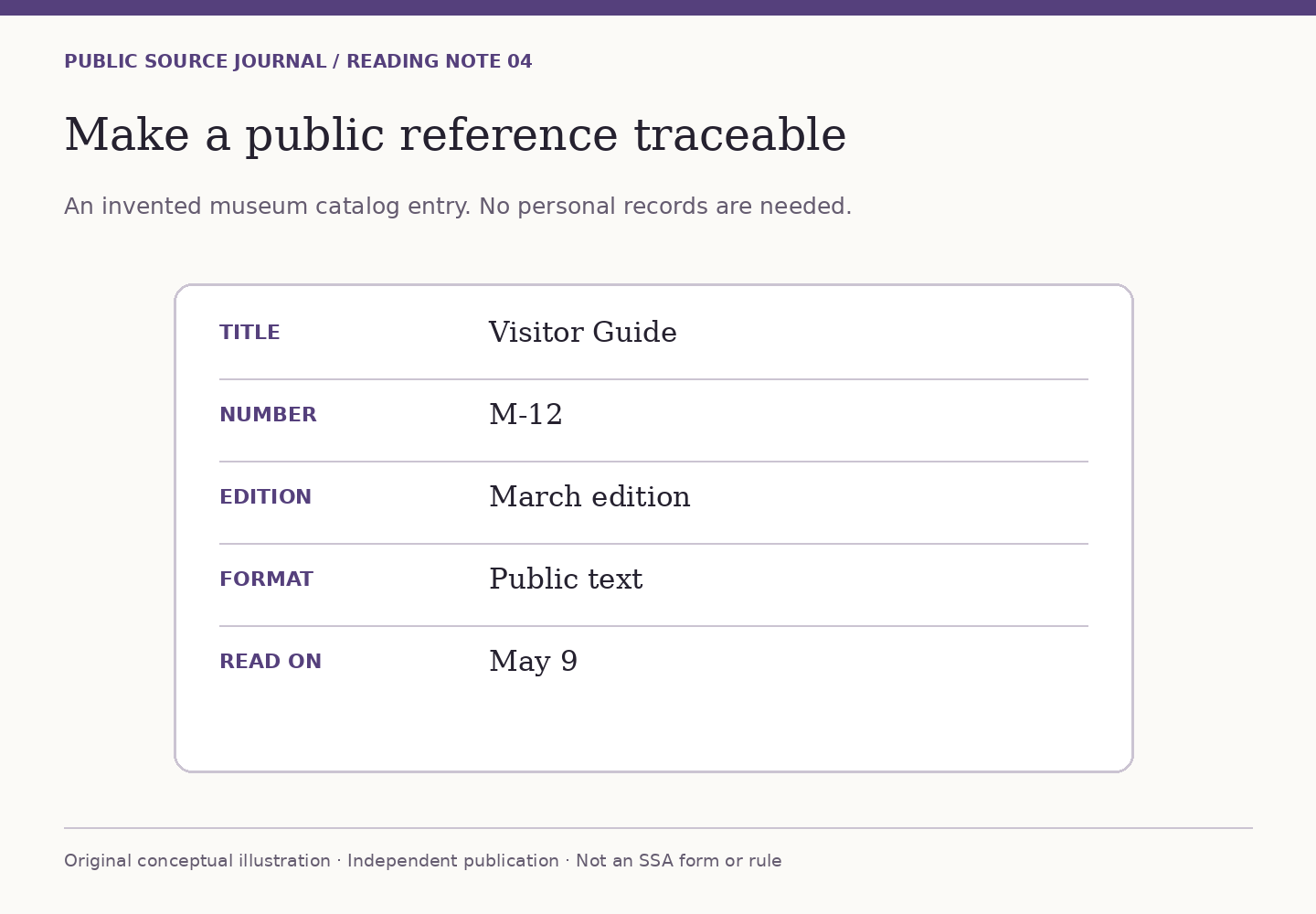
Here is an invented record from an imaginary museum: “Visitor Guide, number M-12, March edition, official catalog, checked May 9.” If the museum later lists a June edition, the note helps you explain exactly what your earlier summary used. It does not prove that every sentence changed, nor that the March edition was wrong when issued. Version awareness is more precise than dividing every document into simply “good” and “bad.”
Compare like with like
Before comparing two statements, check that the documents address the same subject, audience and period. A short overview and a detailed instruction sheet may have different jobs. A translated format may carry its own edition label. Do not assume that two files with similar covers have identical scope or that an audio link is a transcript of every page you remember from another edition.
When a relevant difference appears, record the section or heading and the narrow point that changed. Avoid rewriting an entire summary around a single unfamiliar word. If the difference affects a real action, use the current official source and appropriate official assistance. This Journal cannot decide which document governs an individual matter.
Do not treat availability as a direction to submit
A public catalog can include informational publications near forms or service links. Finding a file does not establish that a person should complete it, qualifies for a program or has met a deadline. This site offers reading literacy only and does not host forms for submission. Replacement Social Security cards are free from SSA; independent reading material is not a required paid gateway to official information.
The most useful outcome is a reference somebody else can follow. A precise catalog citation supports correction, translation checks and later review. Pair it with the three-date distinction so that “edition,” “read on” and “effective” never become accidental synonyms.
Sources and limits
- External official SSA source: Publications. Public catalog lists publication numbers, edition dates and formats. Catalog examples are checked only as listings; no PDF body is claimed as read.
- External official SSA source: replacement-card fee warning. SSA identifies replacement Social Security cards as free. Some other records or services may have fees; no universal no-fee claim is made.
Public sources checked October 8, 2026. Original examples are illustrative, not official text or a decision about any person.