In this article
“Updated” can mean several things. A new article may describe an older event. A policy announcement may discuss a change that starts later. A reading guide may have been checked today even though the source itself has not changed. Treating those dates as interchangeable can turn an accurate sentence into a mistaken conclusion.
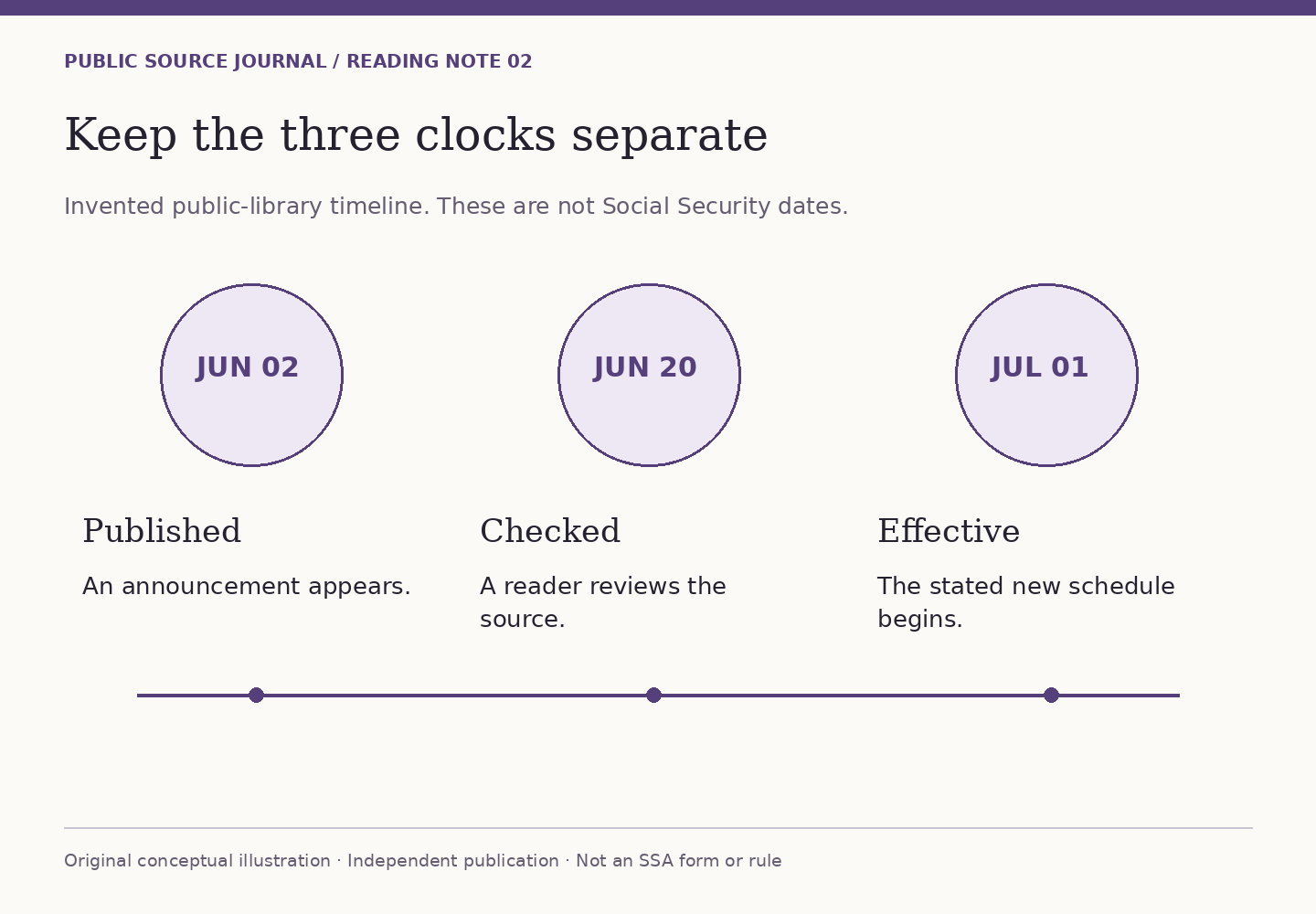
Give each date a job
A publication date tells you when an item was issued or posted. An effective date, when one is stated, tells you when a particular provision or change applies. A source-check date tells you when someone reviewed the reference. This Journal shows source-check dates to make its evidence trail visible. That date is not a claim that we verified a personal account, contacted an office or established the legal effect of a rule.
SSA’s Communications Corner labels different kinds of material, including press releases and blog posts, and shows dates alongside entries. Those labels are useful context for reading. A news listing is an index to a communication; it is not a substitute for reading the relevant public page and its qualifications. We do not infer a program rule from the age of a headline.
Try a fictional timeline
Imagine a public library announces a new reading-room schedule on June 2, says the schedule begins July 1, and a local guide checks the announcement on June 20. A sentence saying “the new schedule was checked June 20” does not mean it began June 20. A sentence saying “announced in June” does not establish which hours apply during a visit in July. This library example is invented and is not a Social Security timetable.
Draw three marks on a line and name each one. Now imagine that the announcement is revised on June 25. A previous source check becomes historical evidence of what was seen earlier. It is not a warranty that the June 20 interpretation still holds. A clear note records what changed, rather than merely replacing every date with the newest day.
Look for the missing date
Some pages do not display an obvious publication or update date. Do not manufacture one from a footer copyright year, a search-result snippet or the day your browser opened the page. You can truthfully record “read on” without claiming “published on.” If timing is material, follow the agency’s own current source and contact route rather than relying on a date inferred by a third-party publication.
A source may also use relative words such as “this year” or “next month.” Those words need the surrounding publication context. Copying a sentence into an undated note strips away that context. In a personal reading note, replace the relative phrase with a verified absolute date only when the source supports it. Otherwise preserve the uncertainty instead of quietly resolving it yourself.
Keep the conclusion narrower than the evidence
Useful notes can be short: “The page was read on October 8; it did not state an effective date for the point I was checking.” That is more informative than an unsupported “current as of October 8.” It describes what the reader knows and what remains unknown. It also gives the next reader a concrete reason to revisit the primary source.
When a date affects a real deadline or your own circumstances, this reading exercise cannot settle it. Use the relevant official notice and qualified assistance where appropriate. For publication research, compare this method with reading publication numbers and editions and handling inconsistent official pages.
Sources and limits
- External official SSA source: Communications Corner. SSA distinguishes press releases and blog entries with dates. A listing date is not treated as a policy effective date.
Public sources checked October 8, 2026. Original examples are illustrative, not official text or a decision about any person.