In this article
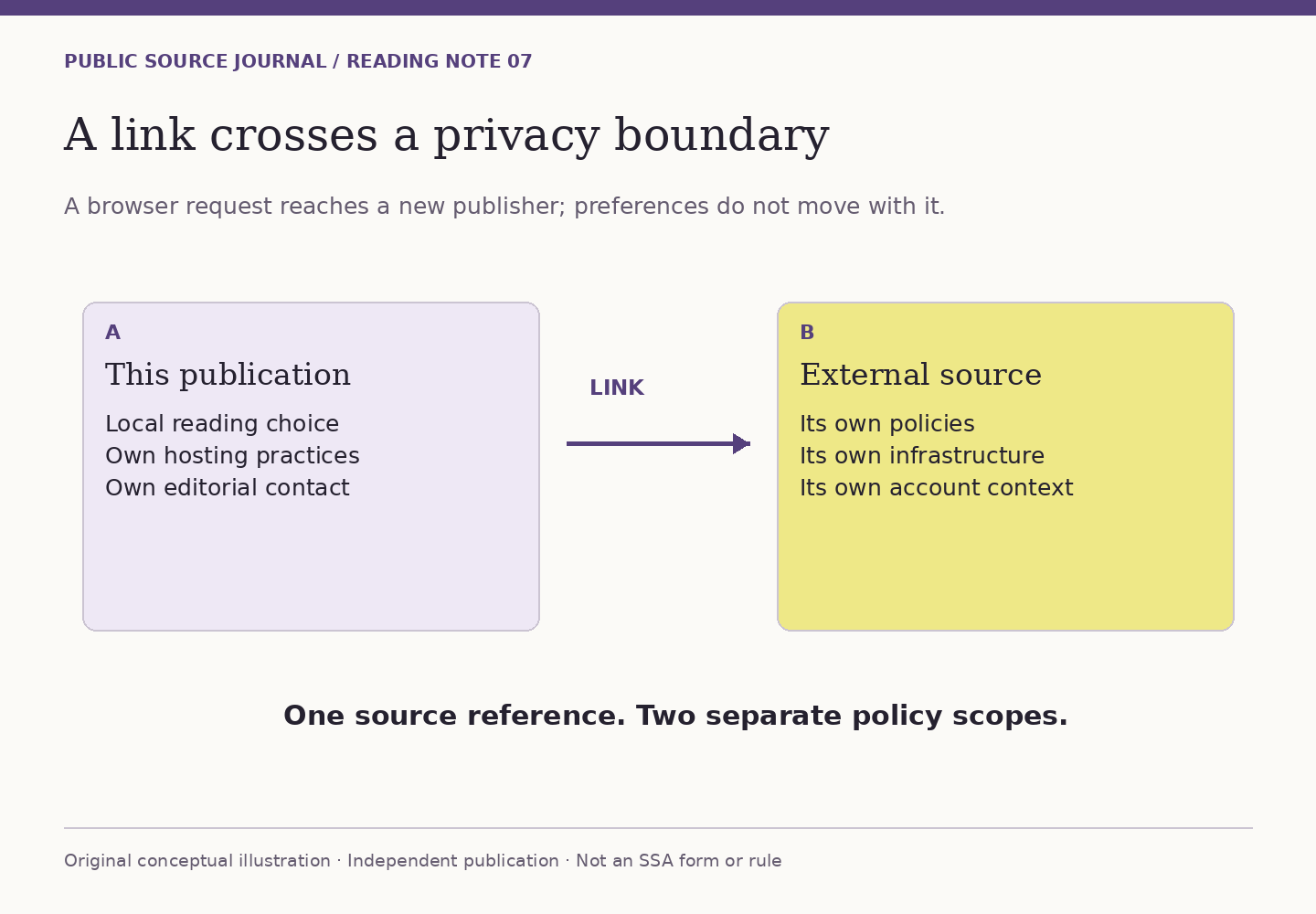
A source link is a connection between pages, not a single shared privacy policy. When you follow a link, your browser makes a request to another destination. That destination may have different logging, storage, account and data-processing practices. Understanding this boundary is especially important when an independent publication cites an official agency.
Read the name on the policy
SSA’s Internet Privacy Policy describes SSA’s online practices and says that it does not cover third-party websites reached from its site. The same basic reading discipline applies in reverse: the Journal’s privacy notice describes this publication, not the agency. An external link does not merge the publishers, their databases or their responsibilities.
Do not infer our practices from a government privacy page. This package does not include advertising tags, analytics or embedded third-party video players. It does include ordinary web requests, site search and optional local reading-position storage. The live host and other plugins can add behavior, which the responsible publisher must assess and disclose accurately before launch.
Distinguish page memory from browser storage
Our reading-path selector uses fixed choices and holds them in the current page’s memory. It does not submit those choices, place them in the address or save them in local storage. Closing or reloading the page resets the tool’s own state, though a browser may independently restore form values. The tool is for selecting articles, not assessing a reader’s situation.
The optional reading-position feature is different. When enabled through cookie settings, it uses this browser’s local storage to help a reader return to a place in an article. Declining keeps that feature off. Withdrawing removes feature-controlled records where browser access permits. See the Cookie Policy for exact names, durations and controls. A choice on this site does not change preferences on SSA.gov or another site.
Search is not a private notebook
A search query appears in the requested address and is sent to the website to retrieve results. That means ordinary hosting and security records may include it. Search only public topics, such as “source dates” or “format.” Do not search your Social Security number, a person’s medical history, an account credential or details from a benefits notice.
Likewise, an email link opens a mail application; it does not create a private case-management system. Email is processed by the sender’s and publisher’s providers. A correction request can identify an article and a public reference without including private records. Our cookie controls cannot erase email correspondence or change a mail provider’s practices.
Check the actual scope of a promise
“No tool submission” is a narrow statement about one feature. It is not a promise that a web visit creates no network traffic or that a host keeps no logs. “Local storage” describes where a feature puts data, not a guarantee about every person who can access the device. Shared devices and browser settings can affect what remains visible.
For the publication’s actual practices, read its Privacy Policy and contact the responsible publisher with a public, non-sensitive question. For an official service, read the policy at that destination. The useful habit is to follow the boundary of the request rather than assuming that trust or preferences automatically travel with a link.
Sources and limits
- External official SSA source: Internet Privacy Policy. SSA describes its own online information practices and explains that its policy does not cover third-party sites. The Journal has a separate privacy notice and no SSA affiliation.
Public sources checked October 8, 2026. Original examples are illustrative, not official text or a decision about any person.